
Cicero Epoxy Flooring installs metallic epoxy floor systems in Cicero, IL, serving surrounding cities including Forest Park, Lyons, River Forest, Brookfield and Summit. Metallic floors are the most decorative coatings we put down, and after 20+ years of preparing concrete we know their beauty depends on two things: a flat, properly ground slab and a crew that knows how to work the pigment while it is still moving.
A metallic floor is a clear epoxy loaded with fine mica pigments. As the coat is spread and manipulated, the pigment shifts and settles, creating marbled swirls, pearl effects, lava-like pools and the look of polished stone or brushed metal.
Because metallic finishes are smooth and reflective, they show what is underneath far more than a flake floor does. So we grind every slab, test for moisture before pricing and repair cracks before any color is mixed, and the written proposal names the product, coat count and finished thickness you are paying for.
Metallic Looks and Techniques
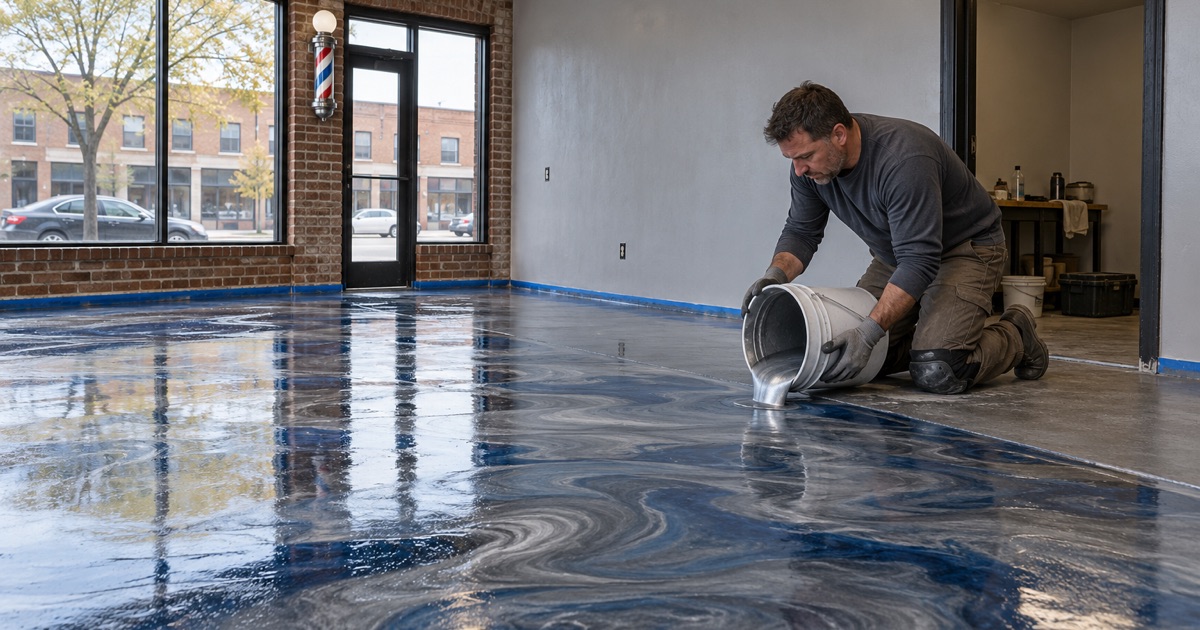
Marbled and Flowing Finishes
The most popular metallic look is a marbled floor with soft veins of lighter and darker color moving across it. Installers create the movement with rollers, trowels and brushes while the coat is still wet, and the pattern keeps developing as the epoxy levels.
Every marbled floor is unique. We agree on colors and the style of movement using sample boards, then control the technique on install day to stay within that look.
Pearl, Lava and Cell Effects
Pearl finishes give a soft, satin shimmer, while lava and cell effects create distinct pools and rings of color. Some cell effects are produced by spraying a small amount of solvent or alcohol onto the wet coat, which pushes the pigment into patterns.
These effects are bolder and take more skill to keep balanced across a large room. We recommend them most often for accent areas, showrooms and spaces where the floor is meant to be a feature.
Multi-Color and Bordered Designs
Two or three metallic colors can be blended in one floor, or separated with borders, inlays and saw-cut lines. Color choices range from silvers and charcoals to coppers, bronzes, blues and deep reds.
Dark bases with lighter metallics tend to show the most depth, while lighter floors look brighter but show dust and scuffs sooner. We help balance color against how the room is actually used.
Matching Metallic Color to the Room’s Light
Metallic pigments change character under different light. A floor that glows under warm basement fixtures can look cooler and flatter in daylight from a garage door, and the swirls show most strongly when light rakes across the surface at a low angle.
We look at sample boards in the room itself, under its own lighting, before the color is ordered. That small step prevents the most common disappointment with metallic floors, a color that looked right in a showroom photo and wrong at home.
Preparing a Slab for a Metallic Floor
Flatness and Diamond Grinding
Metallic epoxy self-levels and pools, so low spots collect more pigment and show as dark patches while high spots look thin. We grind the slab flatter than we would for a flake system and fill low areas before the metallic coat.
Diamond grinding also opens the surface to the profile the primer needs. We never acid etch a floor that is going to receive a decorative coating, because uneven etching shows straight through a metallic finish.
Crack Repair That Will Not Show
Repaired cracks can telegraph through a smooth metallic coat as faint lines. We cut out and fill cracks, grind them flush and apply a primer or body coat before the metallic layer to help hide the repair.
Even with careful work, a crack in a slab that is still moving will reopen and crack the coating above it. We assess cracks at the first visit and tell you if any are likely to show.
Moisture Testing and Primers
Moisture coming up through a slab can cause blisters, which are especially visible in a glossy metallic floor. We test with calcium chloride kits or in-slab relative humidity probes, and where readings are high, a moisture-mitigation primer goes down first.
Basements in older homes, many without vapor retarders under the slab, almost always get tested carefully. A blister in the middle of a marbled floor cannot be invisibly repaired.
Residential Metallic Epoxy Floors
Finished Basements and Living Areas
Metallic epoxy turns a plain basement slab into a finished floor for a family room, bar area or home theater. It is seamless, wipes clean and pairs well with area rugs in seating areas.
Old paint, patching compound and tile adhesive must come off first, and we check older basement floors for these before choosing a system. A metallic coat over leftover glue would show every ridge.
Garages with a Showroom Look
Some homeowners want a garage that looks like a showroom, and metallic epoxy delivers that. We explain the trade-off up front: a smooth metallic floor shows tire marks, scratches and salt residue faster than a flake floor.
In garages we add a UV-stable topcoat with light texture and recommend a satin sheen. Winter salt and brine are wiped up more often on a metallic garage floor if you want it to stay showroom bright.
Kitchens and Entryways
Metallic floors are used in kitchens, mudrooms and entries, where their seamless surface resists spills and cleans easily. We add slip resistance in these spaces, since water and smooth gloss do not mix well underfoot. Many homeowners choose deeper colors in entries, where tracked-in grit is less visible, and lighter tones in kitchens to brighten the room.
Commercial Metallic Epoxy Floors
Showrooms, Salons and Retail
Showrooms, salons, boutiques and restaurants use metallic floors to make a strong first impression. The floor becomes part of the design, and brand colors can be worked into the metallic mix.
For busy commercial spaces, we specify a thicker topcoat for abrasion resistance and schedule work during closed hours where possible. Phasing a store floor in sections can keep part of the space open.
Offices, Lobbies and Houses of Worship
Lobbies, offices and houses of worship use metallic floors in aisles, entries and gathering areas, sometimes paired with flake floors under seating where wear is heavier. The combination gives a decorative path through a space while keeping high-traffic areas practical. We plan these layouts with borders and saw cuts so the two systems meet cleanly.
Durability and Upkeep
A metallic floor’s durability comes from its topcoat. We use polyaspartic or urethane topcoats that resist abrasion and ultraviolet light, and recoating the top layer every few years in heavy-traffic areas keeps the finish looking new.
Routine care is dust mopping and damp mopping with a neutral cleaner. Felt pads under furniture and walk-off mats at entries keep grit from scratching the surface.
Our Step-by-Step Metallic Epoxy Floor Process
Step 1: Design and Slab Assessment
We review sample boards and colors with you, check the slab’s flatness, cracks and existing coatings and run a moisture test. The proposal names the system, coat count and thickness.
Step 2: Grinding, Repair and Primer
The slab is diamond ground, repaired and leveled, then primed. A tinted body coat often follows to set the base color under the metallic layer.
Step 3: Metallic Coat and Topcoat
The metallic coat is poured, spread and worked to the agreed look, then left to level. After it cures, a clear protective topcoat goes on, timed by slab temperature and dew point readings.
Step 4: Cure and Return to Use
We give you walk-on, furniture and full-use times for the products installed, which vary with temperature and topcoat choice. Keeping heavy items and rolling loads off the floor until then protects both the bond and the finish you chose.
- 20+ Years on Concrete
- Moisture Tested Before Pricing
- Written Coat-by-Coat Proposals