Epoxy Flooring in Cicero, Built on a Ground Slab

Garage, basement and commercial floors that start with diamond grinding and a moisture test, and end with a proposal you can check the finished floor against.

Cicero Epoxy Flooring has spent 20+ years grinding and coating concrete, and we install epoxy flooring in Cicero, IL for garages, basements, shops, kitchens, warehouses and plant floors. Our work covers flake and metallic epoxy, polyaspartic coatings, polished concrete, concrete grinding and floor repair, along with ESD flooring for electronics work.

Every floor starts the same way: the slab is opened with a diamond grinder or shot blaster, tested for moisture and mapped for cracks before a system is chosen. That order matters more than any product name, because most coating failures trace back to a slab that was never properly prepared or measured.

What you get from us is a written proposal naming the product line, the number of coats and the finished thickness. When the floor is done, you can check it against that paper rather than against a sales conversation.

Get Your Free Quote

Fast response • No obligation

So we can reach you about your request.

So we can send you a confirmation after you submit this inquiry form.

  • 20+ Years on Concrete
  • Moisture Tested Before Pricing
  • Written Coat-by-Coat Proposals

What we do

Our Services

Ground, tested and coated epoxy floors for Cicero, IL

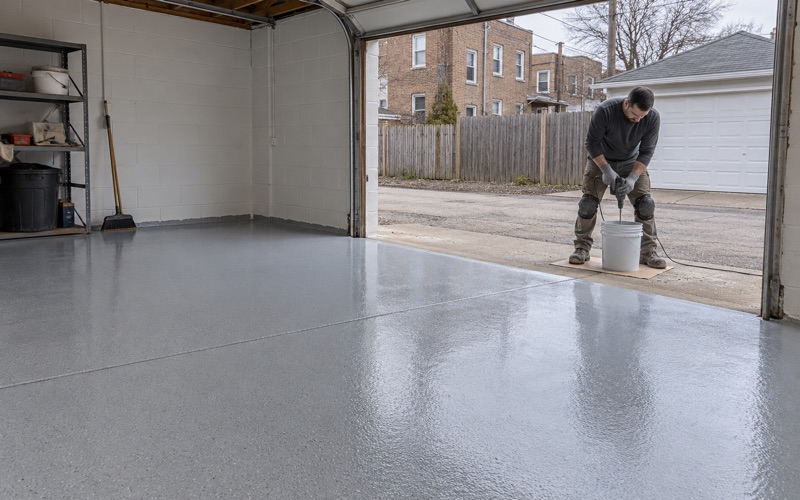
A batch of gray epoxy mixed on the apron of a Cicero alley garage, the slab inside already carrying a fresh base coat.

Epoxy Garage Floor

Ground, moisture-tested epoxy garage floors with flake or solid finishes and salt-resistant topcoats, installed in Cicero and nearby towns.

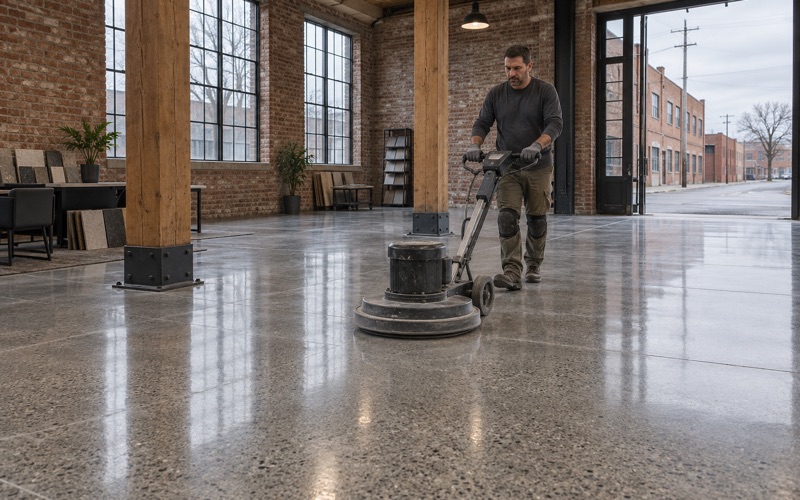
A burnisher bringing up the sheen on a polished concrete floor inside a converted Cicero brick factory showroom.

Polished Concrete Floors

Diamond-ground, densified polished concrete for warehouses, retail spaces and basements in Cicero and surrounding towns.

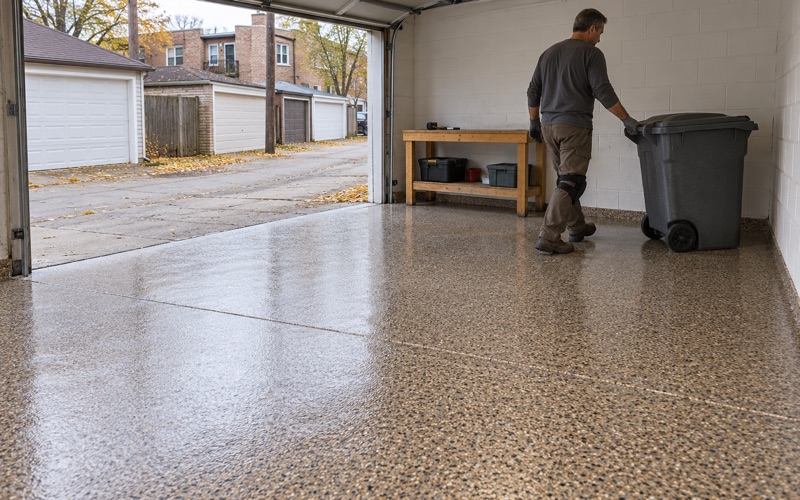
A garbage cart rolled back into a Cicero alley garage the same afternoon its polyaspartic flake floor went down.

Polyaspartic Floor Coating

Fast-curing, UV-stable polyaspartic floor coatings for garages and commercial floors in Cicero and surrounding towns.

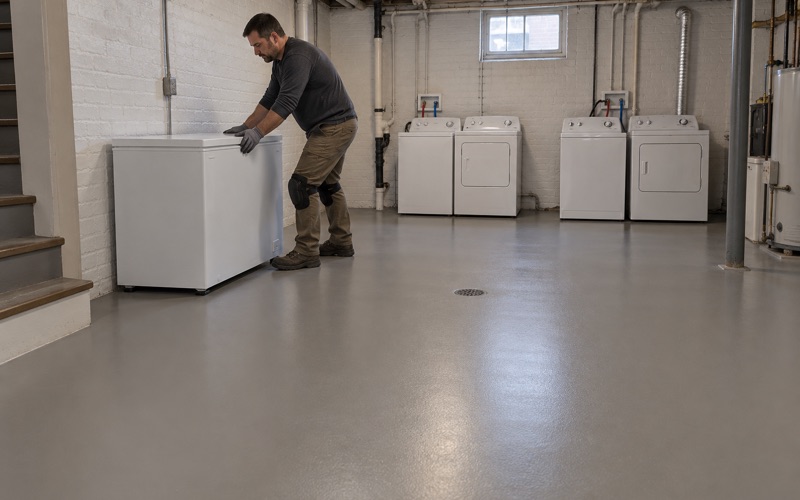
A chest freezer eased back onto a new warm gray epoxy floor in the shared basement of a Cicero two-flat.

Basement Floor Epoxy

Moisture-tested basement floor epoxy for laundry rooms, workshops and finished basements in Cicero and nearby towns.

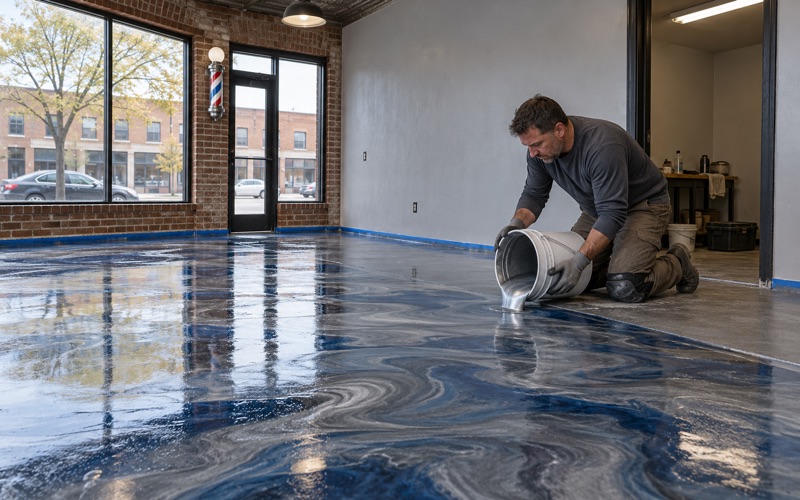
Silver and deep blue metallic epoxy poured in a ribbon across a barbershop floor on a Cicero commercial street.

Metallic Epoxy Floor

Marbled metallic epoxy floors for homes, showrooms and shops in Cicero and nearby towns, installed over a ground, moisture-tested slab.

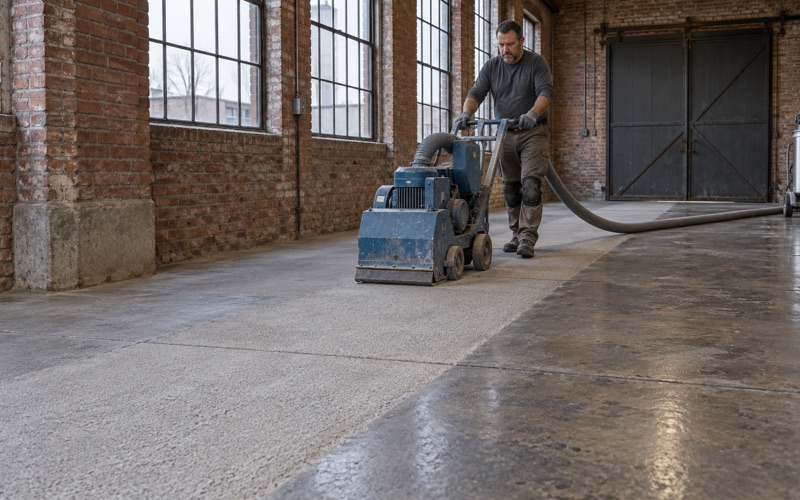
A walk-behind shot blaster opening up an old factory slab in Cicero, a clean blasted lane left behind it.

Concrete Grinding

Diamond grinding and shot blasting to strip coatings and adhesive and profile concrete for new floors in Cicero and nearby towns.

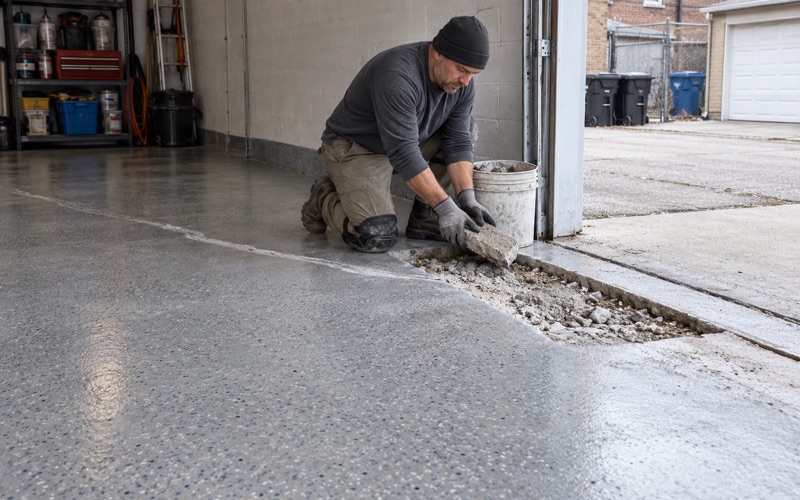
A broken chunk of spalled concrete lifted out of the salt-damaged front edge of a Cicero garage slab before patching.

Concrete Floor Repair

Crack, spall, joint and salt-damage repair for garage, basement and commercial concrete floors in Cicero and nearby towns.

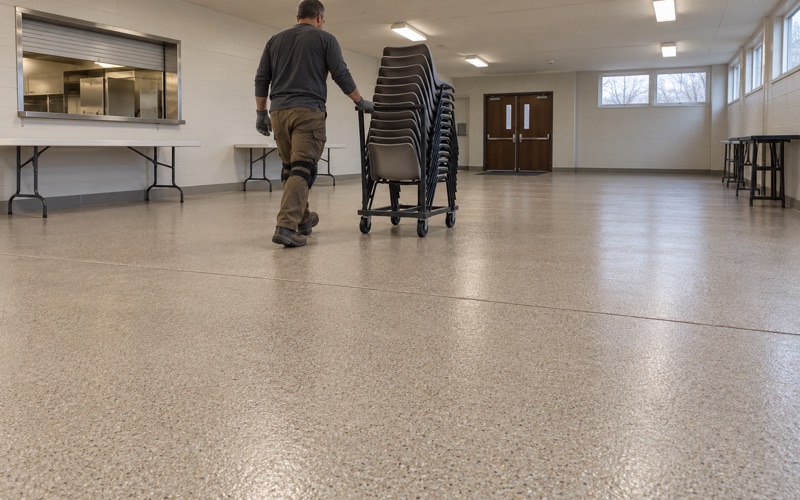
Stacked chairs rolled across a new quartz broadcast floor in a church fellowship hall in Cicero.

Commercial Epoxy Flooring

Commercial epoxy floors for shops, warehouses, retail and service bays in Cicero and nearby towns, phased to keep businesses running.

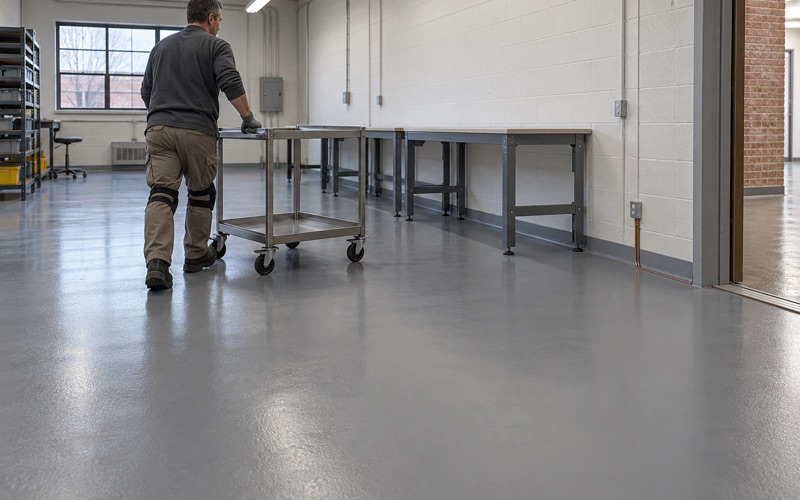
A parts cart rolled across a new static-dissipative floor in a Cicero electronics assembly room.

ESD Flooring

Static-dissipative and conductive epoxy floors for electronics assembly, labs and server rooms in Cicero and nearby towns.

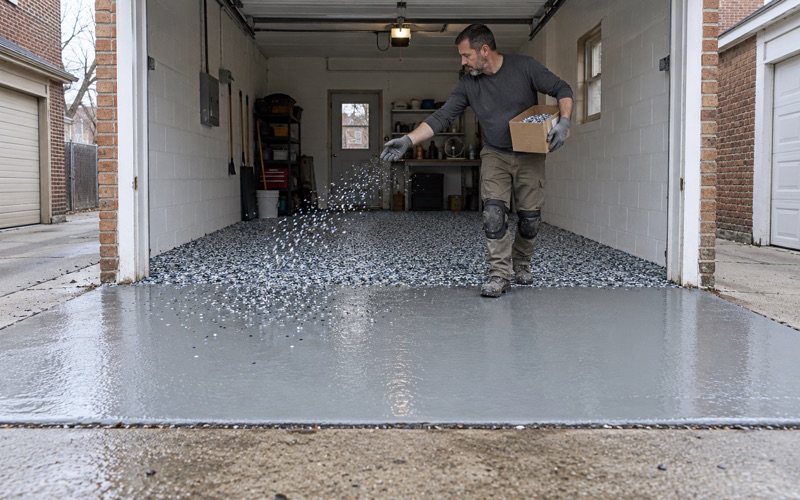
Vinyl chip mid-broadcast over a wet gray base coat in a Cicero alley garage, seen from the alley.

Flake Epoxy Floor

Full-broadcast vinyl flake epoxy floors in custom color blends for garages, basements and commercial spaces in Cicero and nearby towns.

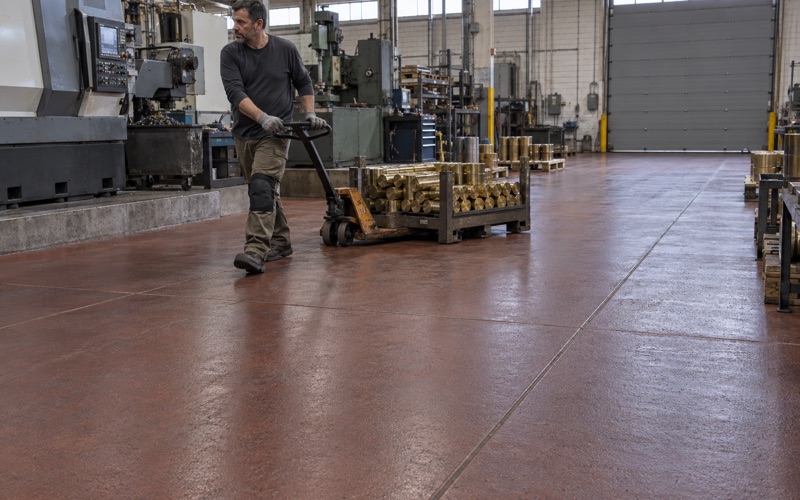
A pallet jack of brass billets pulled across a heavy urethane cement floor in a Cicero metalworking plant.

Industrial Epoxy Flooring

High-build, mortar and chemical-resistant industrial epoxy floors for plants and shops in Cicero and nearby towns, phased around production.

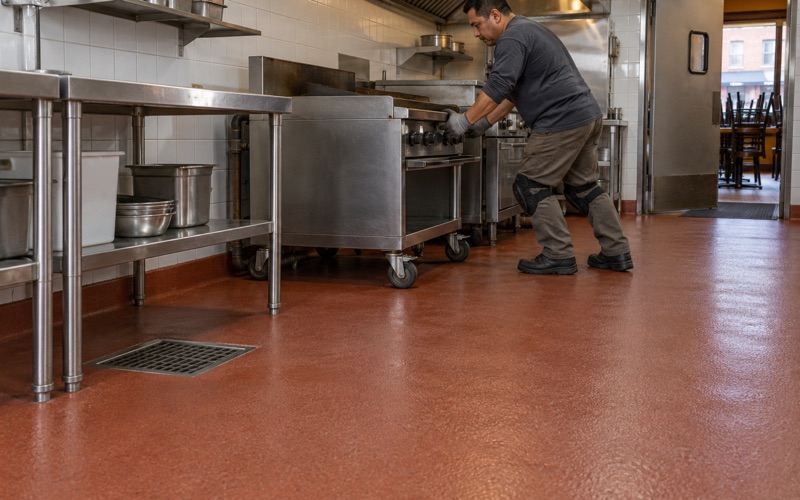
A griddle stand rolled back onto a textured urethane cement floor in a Cicero taqueria kitchen.

Commercial Kitchen Flooring

Seamless, coved urethane cement and epoxy floors for restaurants, taquerias, bakeries and food plants in Cicero and nearby towns.

Experience Behind Every Floor

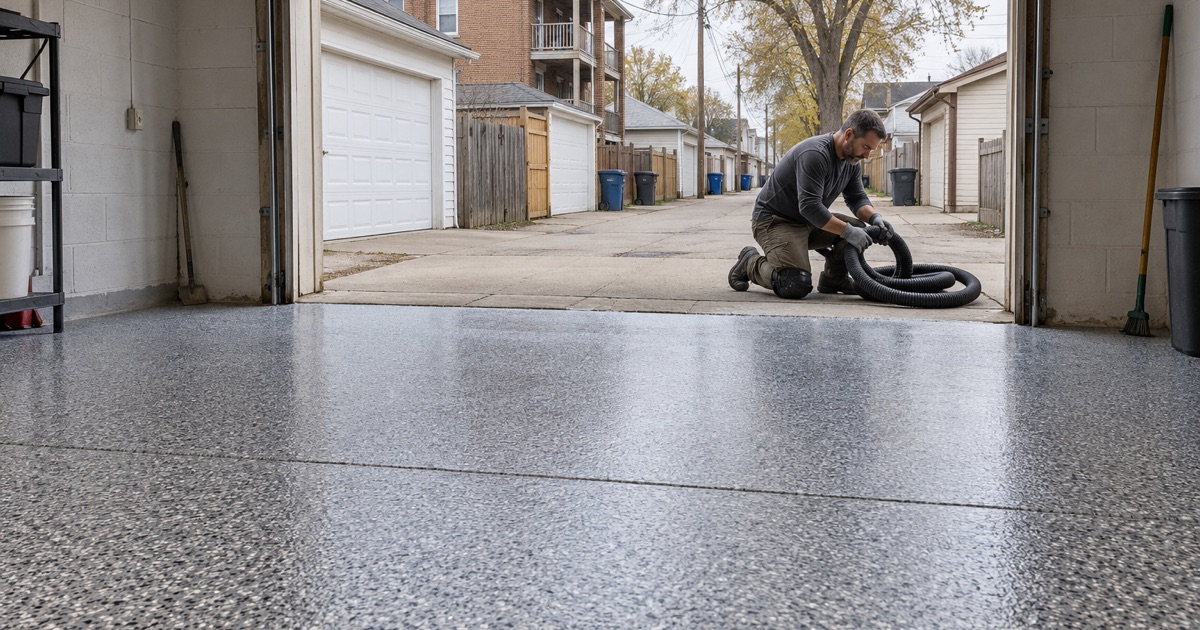
A finished gray and black flake floor in a detached alley garage behind a Cicero brick two-flat, the vacuum hose being coiled at the threshold.

20+ Years Grinding and Coating Concrete

We have been preparing and coating concrete floors for more than twenty years. That time is why our crews read a slab before they quote it, and why the questions about moisture, cracks and old coatings get asked on the first visit instead of after the topcoat is down.

Why Choose Cicero Epoxy Flooring

Mechanical Slab Profiling

No coating goes onto a slab we have only acid-etched. Every floor is opened with diamond grinding or shot blasting to a measured ICRI concrete surface profile, so the epoxy bonds into sound concrete rather than sitting on a weak, etched skin that lets go under a hot tire.

Moisture Measured Before Price

A moisture test is part of the scope before the price is final, for basements and garages alike. In a town where most slabs predate modern vapor retarders, that test decides whether a mitigation primer is needed, so the floor does not blister in its first summer the way a coating guessed onto damp concrete does.

Proposals You Can Measure

Each written proposal names the product line, the coat count and the finished thickness in mils. That lets you hold the finished epoxy floor to the quote, rather than wondering whether a two-coat job quietly became one thin coat once the crew was on site.

Garage Systems Built for Salt

Garage coatings here are specified for the brine and rock salt that ride in on tires from November to March. Chemical-resistant topcoats and a full-build system keep the deicer from reaching bare concrete, so the slab does not scale and pit beneath a finish that only looked sealed.

Cure Set by Dew Point

Never do we schedule a cure by the calendar alone. Slab temperature and the dew point spread at the surface decide when a coat goes down, so an unheated alley garage in January is told to wait rather than coated into amine blush and a soft, cloudy finish.

Local Rules Checked First

Illinois has no state flooring license, and Cicero requires contractors to be licensed and bonded with the town before any permit issues. We check each town’s registration, bond and insurance rules before booking, so a job is not stopped by an inspector halfway through the grind.

Garage Floors, Ground and Coated

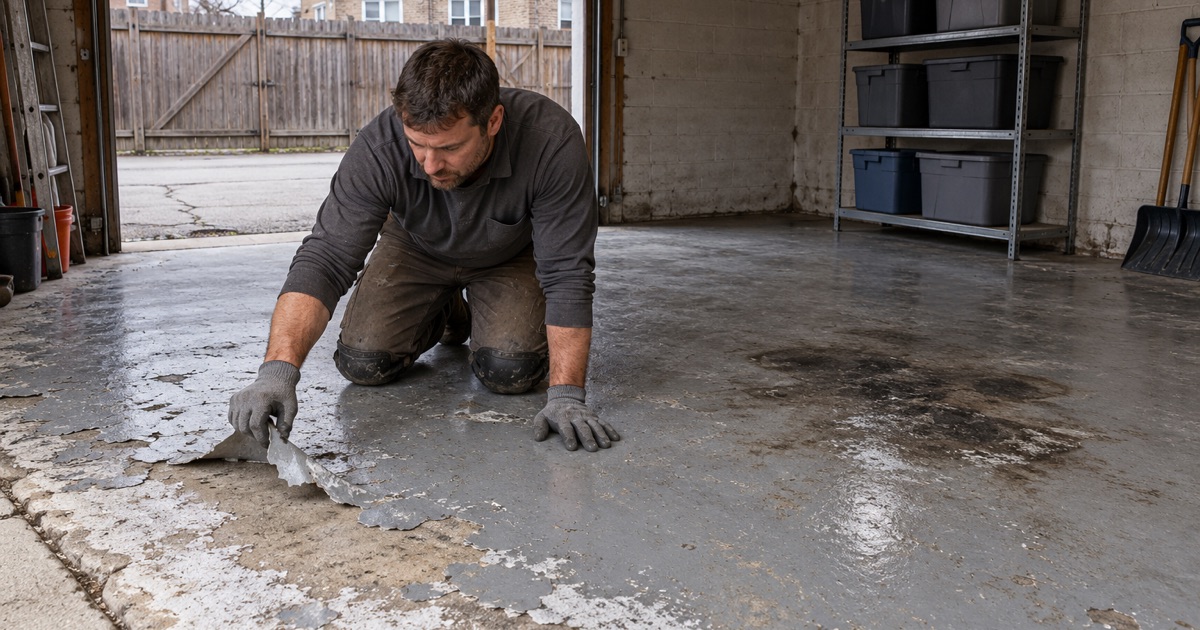
Old flaking floor paint lifted off a salt-scaled garage slab behind a Cicero two-flat before the floor is ground.

How an Epoxy Garage Floor Job Runs

A garage job starts with a slab walk, a moisture check and crack mapping, then a written proposal. Install day begins with grinding and repair, followed by the base coat, broadcast and topcoat, with the return-to-parking date set by the product and the slab temperature.

Staging Alley Garage Coatings from the Alley

Many Cicero garages sit at the back of the lot and open onto an alley. We stage grinders, vacuums and mixing from the alley side, so the yard and the house stay clear and neighbors sharing the alley can still pass.

Grinding Through Sealer and Old Paint

A coating rolled over sealer or garage-floor paint can only bond as well as that old layer holds the concrete. Diamond grinding removes the old film and opens the pores, so the new epoxy anchors to sound concrete instead of peeling off with the paint underneath it.

Moisture Testing a Garage Slab Without a Vapor Retarder

The residential code lets a detached garage slab skip the under-slab vapor retarder, so many garages have nothing stopping ground moisture. We test before pricing, using a plastic sheet screen or calcium chloride kits, and specify a primer that tolerates vapor where the numbers call for one.

Repairing Cracks and Spalls Before Coating

Cracks, spalls and pitting are filled and ground flush before any coat goes down. When a slab has settled, heaved or broken into loose pieces, we say so plainly, because coating a floor that needs replacing only hides the problem for a season.

What Brine and Rock Salt Do to Bare Concrete

Calcium chloride and rock salt melt snow on the street, then drip off the car and soak into a bare garage slab. Repeated freezing and thawing of that salty water scales the surface and pits the paste, which is why an unprotected slab looks worn long before its age.

Coating a Garage in Cold Weather

Most epoxies need the slab, not just the air, to sit above a minimum temperature and stay several degrees above the dew point while they cure. An unheated garage in January often fails both tests, so we schedule it for a warmer stretch or a heated enclosure instead.

Hot Tire Pickup and Cheap Coatings

A tire coming off a warm highway softens a thin coating and, as it cools, pulls the film up off the floor. Hot tire pickup is common with thin single-part paints over unground concrete, and a ground slab with a full-build epoxy and a hard topcoat is the cure.

Store-Bought Kits Compared with a Professional Floor

A retail kit usually relies on an acid etch and a thin water-based epoxy, often a few mils thick. A professional floor is ground, repaired, built up with 100% solids epoxy and finished with a polyaspartic or urethane topcoat, which is the difference between a seasonal finish and a long-lived floor.

What an Epoxy Garage Floor Costs

Published prices for a coated two-car garage in the Chicago area run roughly $1,800 to $4,500. Crack repair, old coatings that must come off, moisture mitigation and the choice of flake or metallic system all move the number, and each line shows up separately in our proposal.

Coating Warranty Exclusions, Starting with Moisture

Moisture rising through the slab is the exclusion most coating warranties name first. We explain it, along with chemical and impact limits and cracks that move after installation, before the job is sold rather than after something goes wrong.

Basements, Floor Drains and Damp Slabs

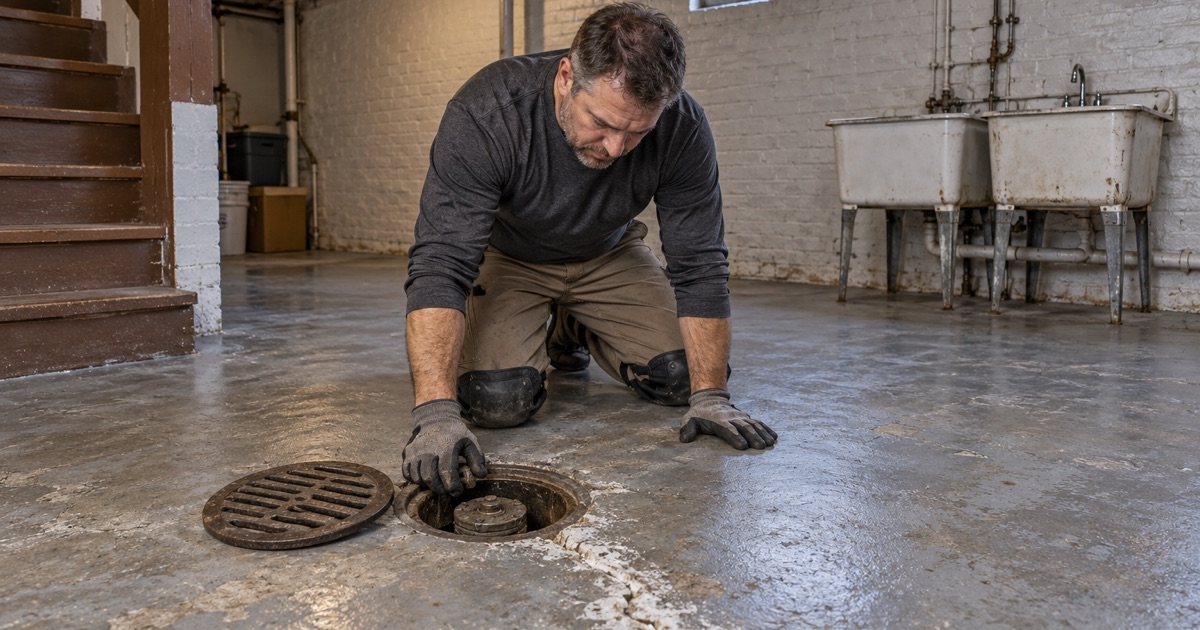
A floor drain cover lifted in a Cicero two-flat basement to check the backflow valve before any coating is chosen.

Coating a Basement Floor After a Moisture Test

Basement slabs sit in the ground, so the first question is how much vapor comes through them. We measure with calcium chloride kits or relative humidity probes, and the result decides the primer and the system before any price is final.

Old Basement Floors with Paint, Patching and Tile Glue

Older basement floors often carry decades of paint, patching compound and black tile adhesive. We check what is there before picking a system, because some layers must be ground off completely and some old adhesives call for careful handling before grinding.

Combined Sewers and Water Rising Through a Floor Drain

Cicero’s sewers carry storm water and sewage in the same pipe. In a heavy storm they can fill and push water back up through a basement floor drain, and no coating stops that, so the drain question comes before the floor question.

Coating After a Sewer Backup

After the July 2, 2023 storm, the town logged more than 6,650 flood-damage reports and some basements held up to three feet of water. A floor that has been under sewer water needs cleaning, disinfecting and full drying, confirmed with a moisture test, before it is fit to coat.

Overhead Sewers and Backflow Valves Come First

An overhead sewer or a backflow valve keeps sewer water from coming up through the floor in the first place. The Town of Cicero installs and reimburses backflow valves through its own program, and we suggest looking into that before spending money on a basement floor coating.

Efflorescence and White Powder on the Floor

White powder on a basement slab is efflorescence: salts carried up by moisture and left behind when the water evaporates. It tells us water is moving through the concrete, so we treat it as a moisture reading rather than a cleaning job.

Moisture-Mitigation Primers for Damp Basements

When test results run above what a standard epoxy tolerates, a moisture-mitigation primer goes down first. It is designed to resist vapor drive from below, so the coating above it does not blister or lose its bond as the seasons change.

Laundry Rooms, Workshops and Home Gyms

A coated basement floor wipes clean under a washer, shrugs off dropped tools in a workshop and gives a home gym a seamless surface. We adjust texture and topcoat to the room, adding grip where floors get wet and choosing harder finishes where weights hit the floor.

What a Basement Floor Coating Costs

Basement pricing moves with square footage, the old layers that must be removed, crack repair and the moisture result. A mitigation primer adds cost but is far cheaper than recoating a floor that failed, and we show it as its own line.

A Floor Coating Is Not Radon Mitigation

In Illinois, radon mitigation is licensed work regulated by IEMA. Sealing a floor is not a radon system, so we never sell a coating as radon reduction and refer anyone with a high test to a licensed mitigation professional.

Flake, Metallic and Polished Looks

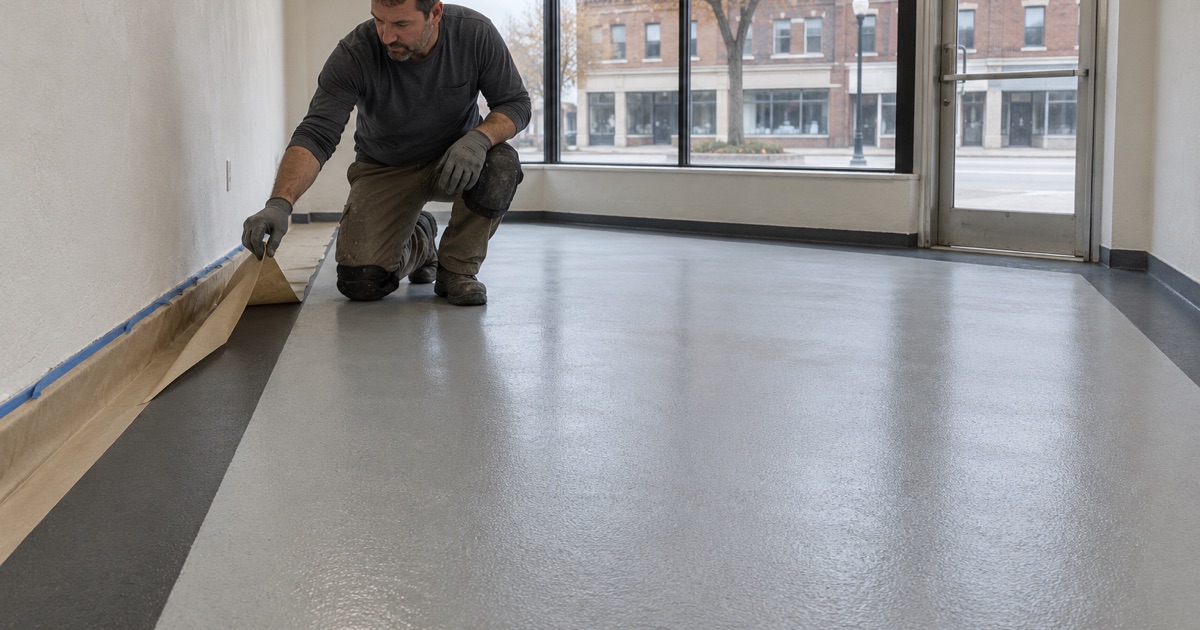
Masking paper peeled back to reveal a contrasting charcoal border band around a pale gray floor in a Cicero shop.

Vinyl Flake Blends and Chip Size

A vinyl flake broadcast hides dust and small imperfections and adds light texture. Larger chips read bold and busy, while smaller chips in a full broadcast give a tighter, granite-like look, and the blend sets the overall color.

Metallic Epoxy Floors and Marbled Finishes

Metallic epoxy uses mica pigments that move as the coat is worked, creating a marbled, three-dimensional finish. It takes a flat, well-ground slab and an experienced hand, because every pass of the roller or trowel stays visible in the cured floor.

Polished Concrete and Aggregate Exposure

Polished concrete is ground in progressive diamond steps and hardened with a lithium silicate densifier. A light grind leaves a cream finish, while a deeper grind exposes salt-and-pepper or larger aggregate, and we test a small area so you see the result first.

Gloss, Satin or Matte Topcoat Sheen

High gloss looks bright but shows dust, scratches and tire marks. Satin and matte topcoats hide everyday wear better, which is why we often suggest them for garages and busy shop floors.

Quartz Broadcast Floors for Color and Grip

A quartz aggregate broadcast locks colored sand into the coating, giving texture and slip resistance in one step. It suits kitchens, ramps, locker rooms and other floors that see water as well as foot traffic.

Solid Color Epoxy Coatings

Sometimes a plain solid color is the right floor, especially in a shop where dropped parts need to stand out or safety lines must read clearly. Solid coats cost less than decorative systems and are simple to touch up.

Sunlight, Ultraviolet Exposure and Ambering

Standard epoxy yellows, or ambers, under ultraviolet light from an open garage door or a sunny window. A polyaspartic or aliphatic urethane topcoat holds its color, so we specify one wherever the floor sees daylight.

Saw-Cut Lines, Borders and Logos

Saw-cut patterns, color borders and logos can be set into a coated or polished floor. Control joints can be honored as design lines too, so the floor’s own cracking pattern becomes part of the layout.

Factory, Warehouse, Kitchen and Shop Floors

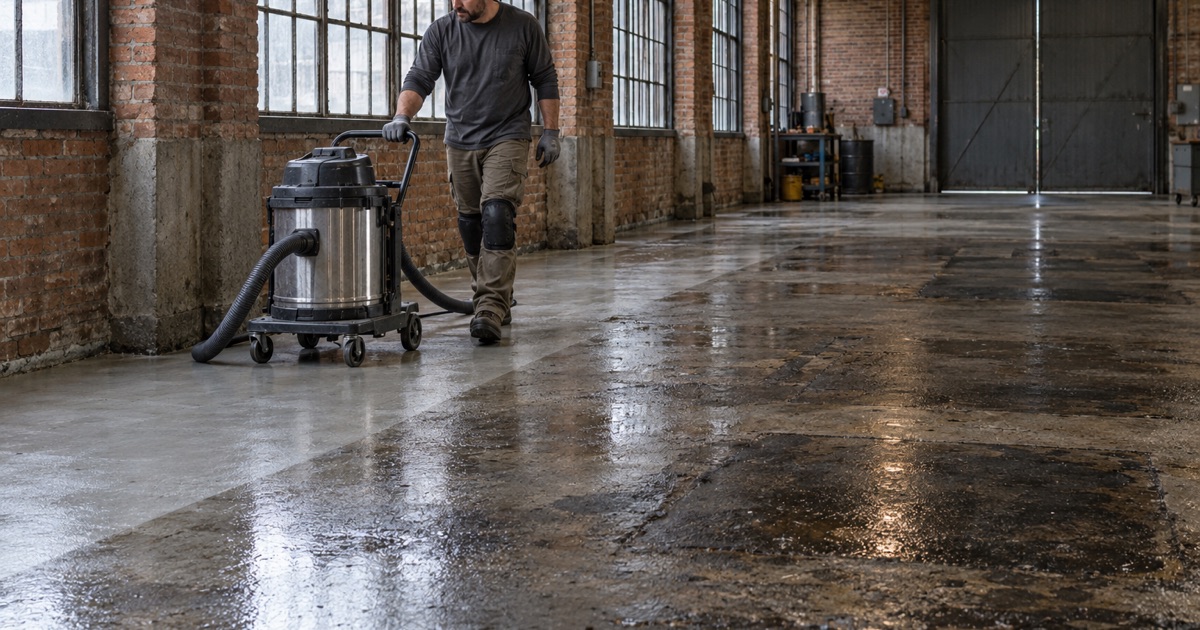
A wet vacuum pulled across an oil-darkened machine shop slab in an old Cicero factory, cleaned before it is coated.

How a Commercial Epoxy Floor Job Differs from a Home Job

Commercial floors are specified against traffic, chemicals, cleaning methods and downtime rather than looks alone. The scope usually involves larger grinders, shot blasting, thicker systems and a schedule built around operations.

Manufacturing Floors with Forklift Traffic

Manufacturing floors take forklift wheel loads, dropped parts and spilled fluids every shift. We specify thicker epoxy or urethane systems with broadcast aggregate for those conditions, so the floor wears slowly rather than chipping out at the busiest aisles.

Cleaning Oil-Soaked Machine-Shop Slabs

Cicero has long been a factory town, and old machine-shop slabs can be saturated with cutting oil. Oil in the pores blocks a coating’s bond, so we degrease, grind and test the cleaned slab before any coat goes down.

Warehouse and Truck Terminal Floors

Pallet jack and forklift wheels concentrate weight on small, hard contact points that crush thin coatings. Warehouse and terminal floors get full-build systems, and dock edges and joint lines get extra attention because that is where damage starts.

Food Plant and Bakery Floors Washed Every Shift

Food plants and bakeries wash floors with hot water and sanitizers every shift. The FDA Food Code calls for smooth, cleanable floors with coved floor and wall junctures, so we specify seamless systems with integral cove base for those rooms.

Restaurant and Taqueria Kitchen Floors

Restaurant kitchens need a floor that handles grease, hot water and constant mopping. A coved base where the floor meets the wall is one of the first things a health inspector checks, and the FDA Food Code’s antislip exception allows textured surfaces where traffic needs grip.

Urethane Cement for Hot Water and Cleaners

Hot water, steam and harsh cleaners can soften a standard epoxy. Urethane cement handles thermal shock and chemical exposure far better, which makes it the usual choice for commercial kitchens and food processing.

Auto Repair and Body Shop Bays

Auto bays see oil, coolant, brake fluid and lifts anchored into the slab. We build chemical-resistant systems in these spaces and work around lift posts and floor drains carefully, since those edges are where coatings tend to fail first.

Static-Dissipative and ESD Flooring

Electronics work needs floors that control static discharge within a specified resistance range. Static-dissipative and ESD epoxy systems are installed with conductive primers and grounding points, and the finished floor is tested against the required range.

Illinois VOC Limits on Floor and Industrial Coatings

Cook County sits inside the Chicago 2015 ozone nonattainment area, and 35 Ill. Adm. Code Part 223 sets VOC limits for floor and industrial maintenance coatings. Those limits apply to whoever applies the product, so we select materials that comply before they reach the job.

Night and Weekend Plant Floor Work

Plants that cannot stop get phased work: one bay at a time, overnight shifts and weekend windows. Fast-cure systems shorten downtime, and we plan the sequence with the plant manager before the first grinder runs.

Areas We Serve

Cicero Epoxy Flooring provides epoxy-flooring throughout the greater Cicero area, with the same crews and the same standards on every job.

Good to know

Frequently Asked Questions

How long does an epoxy garage floor take from start to finish?

Most two-car garages take two to three working days: one for grinding, crack repair and the base coat, then the broadcast and topcoat. Foot traffic usually returns within a day of the last coat, and cars wait longer, set by the product data sheet and the slab temperature rather than a fixed calendar date.

What does an epoxy floor cost in the Cicero area?

Published Chicago-area price bands for a coated two-car garage run roughly $1,800 to $4,500, or about $4 to $10 per square foot. Where a floor lands in that range depends on crack and spall repair, old coatings that must come off, moisture results and the system chosen, and every one of those is written into our proposal.

Does Illinois require a license to install epoxy floors?

Illinois has no state license for flooring or floor-coating contractors. Towns set their own rules instead, and Cicero requires contractors to be licensed and bonded with the town before a permit issues. We check each town's registration, bond and insurance requirements before a job is booked.

Is epoxy or polyaspartic better for a garage floor?

A 100% solids epoxy base is hard to beat for build and bond on a ground slab, while a polyaspartic topcoat cures fast, resists ultraviolet ambering and handles hot tires well. Many of our garage systems use both, an epoxy body with a polyaspartic or polyurea top, so the floor gets the strengths of each.

Will an epoxy coating stop water from coming into my basement?

No. A floor coating does not stop sewer water rising through a floor drain, and it does not hold back water forced through cracks by hydrostatic pressure. Those are drainage and backflow problems, and we point to them before discussing any coating for a basement that has flooded.

How do you test a slab for moisture?

Depending on the floor, we use an ASTM D4263 plastic sheet test as a first screen, ASTM F1869 calcium chloride kits to measure the vapor emission rate, or ASTM F2170 relative humidity probes set into the slab. The results decide whether a moisture-mitigation primer goes down before the build coats.

What does a coating warranty usually exclude?

Moisture coming up through the slab is the most common exclusion, followed by damage from chemicals or impacts outside the system's rating and cracks that move after installation. We go through the exclusions in writing before the job is sold, so nobody discovers them after a failure.

Can you coat a commercial floor without shutting down production?

Usually, yes. We phase plant, warehouse and shop floors around shifts and use overnight and weekend windows where a line cannot stop. Fast-cure materials such as polyaspartics and some urethane cements shorten the return-to-service time when a weekend is all the schedule allows.

Can a basement floor be coated in an older Cicero home?

Most can, once the floor has been checked for paint, patching compound and old tile adhesive and tested for moisture. Older slabs were often poured without a vapor retarder, so the moisture result decides the primer, and some floors need repair before any coating is worth installing.

Ready to Get Started?

Request a free quote today and we'll get back to you fast.