
Cicero Epoxy Flooring provides concrete grinding in Cicero, IL, serving surrounding cities including Forest Park, Lyons, River Forest, Brookfield and Summit. Grinding is the step that decides whether a floor coating lasts, and after 20+ years of preparing slabs we treat it as the most important part of every job rather than a chore before the real work.
We grind concrete to strip old paint, sealers and adhesive, to flatten high spots and to give a new coating a surface it can actually grip. We do not use acid etching on any floor we prepare, because it cannot remove the layers that most often cause coatings to fail. Grinding work is also available on its own, for owners and installers who need a slab cleaned up and profiled before another trade puts down a finished floor.
Surface Profiles and Why They Matter
The ICRI CSP Scale
The International Concrete Repair Institute publishes a concrete surface profile scale, CSP 1 through 10, with physical chips that show each level of roughness. Thin coatings and sealers call for a light profile around CSP 1 to 3, while thicker epoxy and urethane cement systems need deeper profiles.
We grind or blast to the range the coating manufacturer specifies and check the result against profile chips. Too smooth and the coating has nothing to grip, too rough and a thin coat cannot fill the peaks.
Removing Laitance and Weak Surface Paste
Freshly troweled concrete has a thin, weak top layer called laitance, and older slabs often have a dusty, worn surface. A coating bonded to either one is only as strong as that weak layer.
Grinding takes the surface down to sound concrete. The coating then bonds to the dense body of the slab, which is far stronger than the paste that was sitting on top.
Why Acid Etching Falls Short
Acid etching reacts with exposed cement paste but does nothing to sealers, paint, curing compounds or oil. It produces uneven results, leaves salts that must be rinsed away and soaks water into a slab that then has to dry before coating.
That is why retail coating kits rely on etching and why many of those floors peel. Mechanical preparation is what coating manufacturers specify for a reason.
Grinding, Shot Blasting and Scarifying
Diamond Grinding
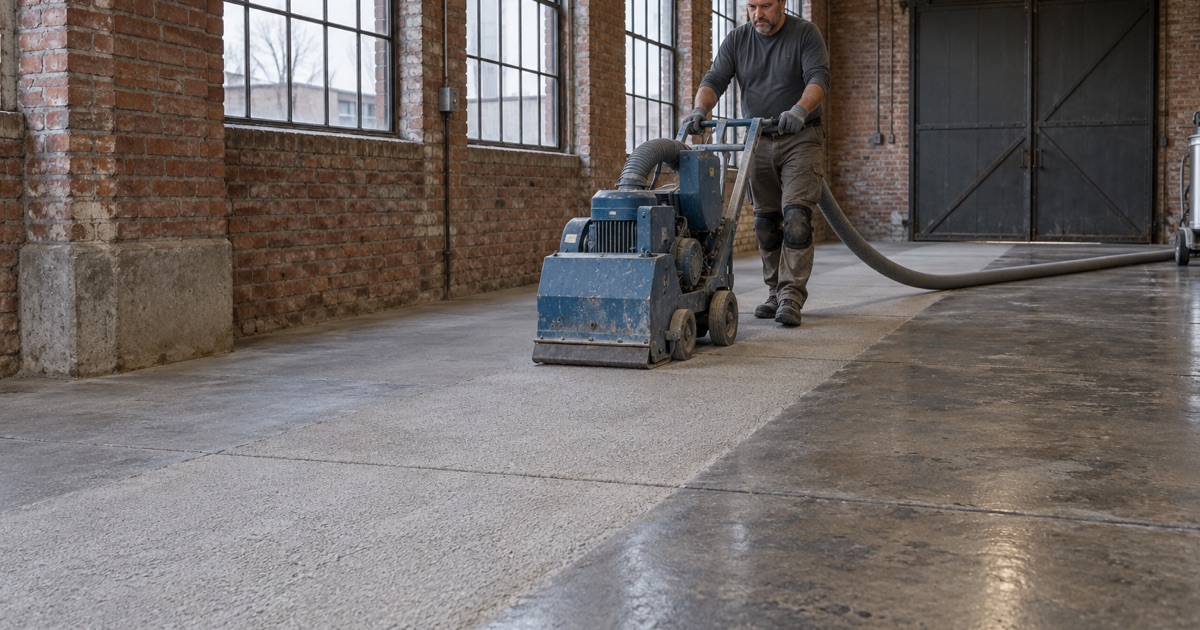
Diamond grinders use rotating heads fitted with metal-bonded diamond segments. Different grits and bonds handle different jobs, from removing thick coatings to light profiling and flattening.
Grinding is our go-to method for garages, basements and most interior floors. It gives good control near walls and around obstacles, and edges are finished with smaller hand grinders so the profile is consistent all the way to the wall.
Shot Blasting
Shot blasting throws steel shot at the surface and recycles it through the machine, leaving an even, textured profile. It is fast on large open floors such as warehouses and plants and works well for thicker industrial coating systems.
Shot blasting does not flatten a floor the way grinding does, and it is less suited to tight spaces. We often use both methods on one commercial job, blasting the open areas and grinding edges and corners.
Scarifying and Heavy Removal
Thick coatings, built-up mastic and badly damaged surfaces sometimes need a scarifier, which uses rotating cutters to chip material away. It leaves a rough surface that is then ground smoother for the new system. We choose the method based on what is on the floor and what is going on next, rather than using the same machine on every job.
Flattening High Spots and Lippage
Slabs that have heaved slightly, or that meet at uneven joints, leave ridges called lippage. Tile, vinyl plank and decorative coatings all show these ridges, and some flooring products have strict flatness tolerances.
Grinding knocks down high spots and evens out joints, and low areas are filled with a patching or self-leveling material afterward. We check the floor with a straightedge so the next layer starts on a surface that meets its installer’s requirements.
What We Remove from Concrete
Old Coatings, Paint and Sealers
Garage paint, worn epoxy, acrylic sealers and floor enamel are all ground off before a new system goes down. A new coating over an old one depends on that old layer staying attached, and most failing floors are failing at exactly that bond. We test how well existing coatings are holding before deciding whether to remove them fully or prepare them for a recoat.
Adhesive, Mastic and Thinset
Floors that once held tile, carpet or vinyl often carry adhesive residue, black mastic or thinset mortar. These clog standard grinding tools, so we use tooling designed to cut through them without gumming up.
Older adhesives are checked before grinding, because some may need testing for hazardous content. Older basement floors in particular are checked for paint, patching compound and glue before a system is picked.
Oil and Shop Contamination
Cicero’s industrial history means some slabs in older shops and garages are soaked with cutting oil, hydraulic fluid or motor oil. Oil blocks a coating’s bond, and it can keep wicking up from deep in the slab after the surface looks clean.
We degrease, grind and then test how much oil remains. Heavily saturated areas may need repeated cleaning or a specialized primer before a coating can hold.
Dust Control and Clean Job Sites
Vacuum at the Machine
Concrete dust is fine and travels easily, so our grinders run with vacuums that capture dust at the cutting head. That protects the crew, keeps homes and businesses cleaner and cuts down on cleanup after the job.
We do not rinse grinding slurry toward floor drains or down driveways. In a town with combined sewers, keeping concrete dust out of the drain is simply good practice.
Working in Occupied Spaces
In homes, two-flats and businesses that stay open, we set up dust barriers, protect adjacent rooms and plan the order of work so access to laundry, stairs or exits is maintained. Commercial grinding can be scheduled for nights and weekends. Alley garages are staged from the alley, which keeps equipment and dust away from the house and the yard.
- 20+ Years on Concrete
- Moisture Tested Before Pricing
- Written Coat-by-Coat Proposals