
Cicero Epoxy Flooring installs basement floor epoxy in Cicero, IL, serving surrounding cities including Forest Park, Lyons, River Forest, Brookfield and Summit. A basement is the hardest residential floor to coat well, and after 20+ years on concrete we approach every one by answering the moisture question before anything else is decided.
Basement slabs sit in the ground, many have no vapor retarder beneath them and older floors carry layers of paint, patching compound and tile glue. A coating rolled over any of that without testing and preparation is a coating on borrowed time.
So a basement job with us starts with a moisture test that is part of the scope before the price is final, a look at what is already on the floor and an honest conversation about drains and backups. The written proposal then names the product, the number of coats and the finished thickness, plus what the warranty does not cover, with moisture first on that list.
The Moisture Question Comes First
Testing a Basement Slab
We begin with an ASTM D4263 plastic sheet test, taping polyethylene to the slab and checking for condensation underneath. That screen tells us whether moisture is moving, and where it matters we measure how much with ASTM F1869 calcium chloride kits or ASTM F2170 relative humidity probes drilled into the concrete.
Those numbers are compared with the coating manufacturer’s limits and with the ASTM F710 moisture thresholds used for floor finishes. The results decide whether a standard epoxy primer is enough or whether the floor needs a dedicated mitigation system.
Hydrostatic Pressure and Efflorescence
Groundwater pressing up against the bottom of a basement slab is hydrostatic pressure. When it is strong, it pushes water through cracks and joints and can force a coating off the surface from beneath, no matter how well it was applied.
Efflorescence, the white powdery salt that appears on damp basement floors, is a visible sign that water is moving through the concrete. We read it as evidence, not as a cleaning job, and it shapes the primer we specify.
Moisture-Mitigation Primers
When readings are higher than a standard epoxy tolerates, a moisture-mitigation primer is applied first. These primers are formulated to resist vapor drive from below and give the build coats a stable base, so the floor does not blister in summer when vapor pressure rises.
A mitigation primer adds cost and sometimes a day to the schedule. It costs far less than grinding off and replacing a coating that lifted, which is why we include it whenever the test results call for it.
Older Slabs Without a Vapor Retarder
Modern slabs are often poured over a vapor retarder meeting ASTM E1745, which slows ground moisture from entering the concrete. Many older basement floors were poured without one, and with most of Cicero’s homes built in 1939 or earlier, that describes a lot of local basements.
Without a retarder, the slab draws moisture from the soil year-round. That is the main reason we never price a basement coating before testing.
Floor Drains, Sewers and Backups
Combined Sewers and Rising Water
Cicero’s sewers are combined, carrying storm water and sewage in the same pipes. In a heavy storm the system can surcharge and push water back up through basement floor drains, and no floor coating can stop that.
We say this plainly before a basement job is sold. If your floor drain has backed up, the drain and backflow question comes before the coating question.
Coating After the July 2023 Flood
On July 2, 2023, nearly nine inches of rain fell in less than a day. The town logged more than 6,650 flood-damage reports, and some basements held up to three feet of water.
A basement that has been flooded with sewer water needs cleaning, disinfection and complete drying before it can be coated. We confirm dryness with a moisture test rather than by eye, because a slab can look dry on top while still holding water deep inside.
Backflow Valves and Overhead Sewers
A backflow valve closes when sewer water tries to flow back into the house, and an overhead sewer routes basement fixtures up to the sewer line so the drain cannot back up. The Town of Cicero installs and reimburses backflow valves through its own program, funded with federal disaster-recovery money.
We point homeowners toward that program and a licensed plumber before coating. Protecting the basement from sewer water is what makes a new floor worth having.
Preparing an Old Basement Floor
Paint, Patching and Old Adhesive
Older basement floors frequently carry several coats of paint, patches of leveling compound and black adhesive left from tile removed years ago. We check what is there before picking a system, because each layer behaves differently under a grinder.
Some old tile adhesives may contain materials that need testing before grinding, and we raise that possibility rather than assume. Once the floor is cleared to grind, every layer comes off down to sound concrete.
Grinding, Not Etching
We open basement slabs with diamond grinding, never with an acid etch. Acid adds water and residue to a floor where moisture is already the main concern, and it leaves an uneven, weakened surface.
Grinding dust is collected with vacuums at the machine, which keeps the basement and the rest of the house cleaner during the job. Nothing is rinsed toward the floor drain.
Cracks, Joints and Uneven Areas
Cracks are cut open and filled, spalls are patched and high spots are ground down. If a crack is actively leaking water, it needs to be addressed as a water problem first, because filling it with coating material will not hold back pressure from below.
We also note settled or broken sections. If part of the slab needs replacing before it can be coated, you hear that at the first visit.
Living on a Coated Basement Floor
Laundry Rooms and Utility Areas
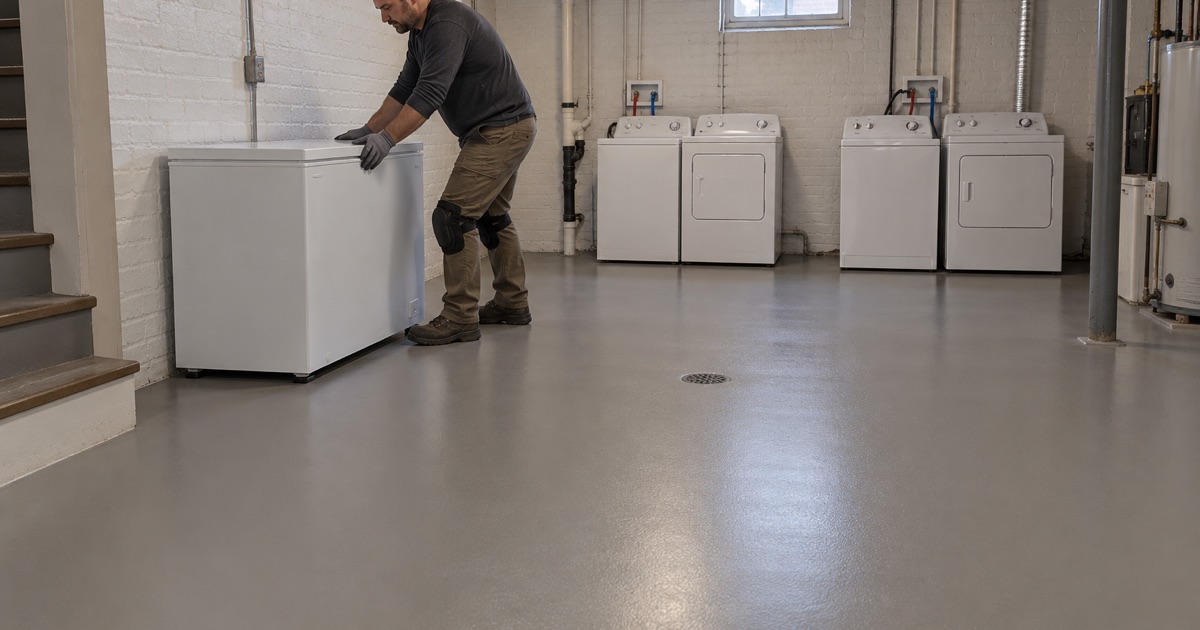
A coated laundry floor wipes clean under washers and around utility sinks, and spills do not soak into the concrete. We often add a light texture where water hits the floor so it is not slippery underfoot. Furnaces, water heaters and appliances are worked around or moved with care, and we plan the schedule so the laundry is not out of service longer than necessary.
Workshops and Home Gyms
Workshop floors take dropped tools, solvents and rolling toolboxes, so a thicker epoxy build with a durable topcoat suits them. Home gyms benefit from a seamless coating under rubber mats, which keeps dust and moisture from collecting beneath them. For finished rooms, flake or solid color systems give a clean, bright floor that suits a family room, storage area or playroom.
Two-Flats and Shared Basements
Two-unit buildings make up 29.0 percent of Cicero’s housing, and many share one basement. In those buildings the floor decision usually involves an owner and tenants who use the space for laundry and storage.
We can phase work around shared laundry access and give the owner a written scope that explains timing to tenants. Home repair jobs over the state threshold get a written contract and the Illinois consumer-rights pamphlet before any grinding starts.
Radon Is a Separate Question
In Illinois, radon mitigation is licensed work regulated by IEMA. A basement floor coating is not a radon system, and we never present one as radon reduction.
If you have a high radon reading, we recommend a licensed mitigation contractor. A coated floor can be installed alongside a mitigation system, and we work around any existing suction points.
- 20+ Years on Concrete
- Moisture Tested Before Pricing
- Written Coat-by-Coat Proposals