
Cicero Epoxy Flooring handles concrete floor repair in Cicero, IL, serving surrounding cities including Forest Park, Lyons, River Forest, Brookfield and Summit. Repair is where many coating jobs are won or lost, and in more than 20 years of grinding and coating floors we have learned to map cracks, spalls and old coatings before anything else is planned.
Repairs are done either as preparation for an epoxy or polished floor or as a standalone service. Either way, we tell you plainly when a slab needs replacing or leveling rather than patching, because no repair or coating holds together concrete that is still moving apart.
Most of Cicero’s homes were built in 1939 or earlier, and their garage and basement floors carry decades of settling, old patches and salt damage. Those floors can usually be brought back, but only with repairs chosen for what actually went wrong.
Cracks in Concrete Floors
Static and Moving Cracks
Not every crack is the same. A static crack formed as the concrete shrank and has not moved since, while an active crack still opens and closes with settling, frost or heavy loads.
We look at crack width, offset between the two sides and signs of recent movement before choosing a repair. Static cracks get a rigid fill that can be ground flush, while active cracks get flexible materials or are turned into planned joints.
Filling and Grinding Cracks Flush
Cracks are cut open with a diamond blade or crack chaser to remove loose edges and give the filler something to hold. They are vacuumed clean and filled with epoxy, polyurea or a cementitious repair material.
Once cured, the fill is ground flush with the surrounding floor. That gives a flat surface that a coating can go over or that can be polished along with the rest of the slab.
When Cracks Signal Bigger Problems
Wide cracks with one side higher than the other, cracks that keep growing or networks of cracks over soft, hollow-sounding concrete point to problems below the slab. Patching the surface will not fix them.
We tell you when a floor needs leveling, sub-base repair or partial replacement before it is worth repairing or coating. That honesty saves money compared with coating a floor that will crack again.
Spalls, Pitting and Salt Damage
Spalled and Broken Areas
Spalls are chunks broken out of the surface, often along joints, edges and near drains. They catch tires and wheels and keep growing as edges crumble.
We cut spalled areas back to sound concrete with clean, square edges and fill them with an epoxy mortar or fast-setting repair compound. The repair is then ground level with the rest of the floor.
Salt Scaling on Garage Floors
Winter brine, rock salt and calcium chloride come in on tires and soak into bare garage concrete. As that salty water freezes and thaws, the top layer flakes away and leaves a rough, pitted surface.
Scaled areas are ground to sound concrete and resurfaced or filled. A coating afterward keeps salt from reaching the concrete again, which is the only way to stop the damage from returning.
Pitting and Surface Wear
Old slabs often have pits, popouts and worn paths where the surface paste has eroded. These hold dirt, trap water and show through thin coatings.
We fill pits with a fine patching compound or a body coat of 100% solids epoxy that builds the surface back to an even plane. On polished floors, small pits are filled with a grout coat during the grinding steps.
Joints, Edges and Drains
Control Joint Repair
Control joints are cut into slabs so they crack in a straight line instead of randomly. Over time, joint edges chip and open, especially under carts and forklift wheels.
We rebuild broken joint edges with epoxy mortar and refill joints with a semi-rigid filler that supports wheel traffic while allowing slight movement. On a coated floor, joints can be honored as visible lines or filled and coated over.
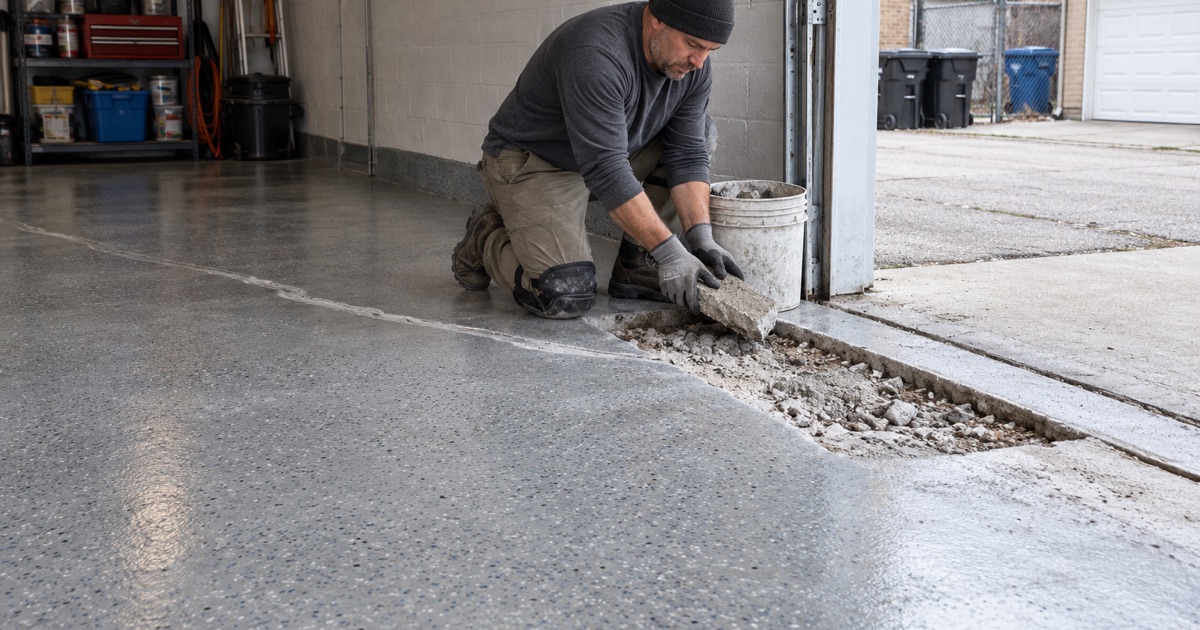
Edges Near Garage Doors
The edge of a garage slab at the door takes salt, water, tire impact and frost more than any other spot. It is often the first place a floor breaks down. We rebuild crumbling door edges with repair mortar shaped to the original profile, so the door still seals and water still runs outward.
Floor Drains and Sloped Areas
Basement and commercial floor drains often have broken concrete around them where water, cleaning and settling have worked on the edges. We rebuild drain surrounds so they slope properly and give a sound edge for the coating to stop against.
Repairs around drains do not change how a drain behaves in a sewer backup, though. In Cicero’s combined-sewer system, a backflow valve or overhead sewer is what keeps water from coming up through the floor.
Repair Materials Matched to the Floor
Epoxy and Polyurea Fillers
Epoxy mortars are strong and bond well to dry concrete, making them good for spalls and static cracks indoors. Polyurea fillers cure quickly and keep some flexibility, which suits joints and cracks that move slightly. Both can be ground flush and coated over, and both set fast enough to keep a project on schedule.
Cementitious and Urethane Cement Repairs
Cement-based patching materials suit areas that will stay bare or be polished, since they look and wear more like the original slab. Urethane cement mortars are used in commercial kitchens and food plants where repairs face hot water and harsh cleaners. We choose the material based on traffic, chemicals and the finish going on top, not on what happens to be on the truck.
- 20+ Years on Concrete
- Moisture Tested Before Pricing
- Written Coat-by-Coat Proposals