
Cicero Epoxy Flooring installs industrial epoxy flooring in Cicero, IL, serving surrounding cities including Forest Park, Lyons, River Forest, Brookfield and Summit. Industrial floors take punishment that no garage or showroom ever sees, including steel wheels, dropped parts, hot fluids and process chemicals, and after 20+ years of preparing and coating concrete we specify these floors around the conditions they will actually face, not around a brochure.
Cicero calls itself a factory town for good reason. Electroplating and anodizing shops, metal finishers, a brass and copper extruder and a gear works all operate here under industrial wastewater permits, alongside large warehouses and the rail yards that serve them. Floors in those buildings carry heavy loads, chemicals and decades of oil, and they need systems built for that.
Every industrial proposal we write names the system, the number of coats or lifts and the finished thickness, along with the surface preparation method. That lets a plant engineer or maintenance manager check the installed floor against the specification instead of taking it on trust.
The Industrial Floor Build Ladder
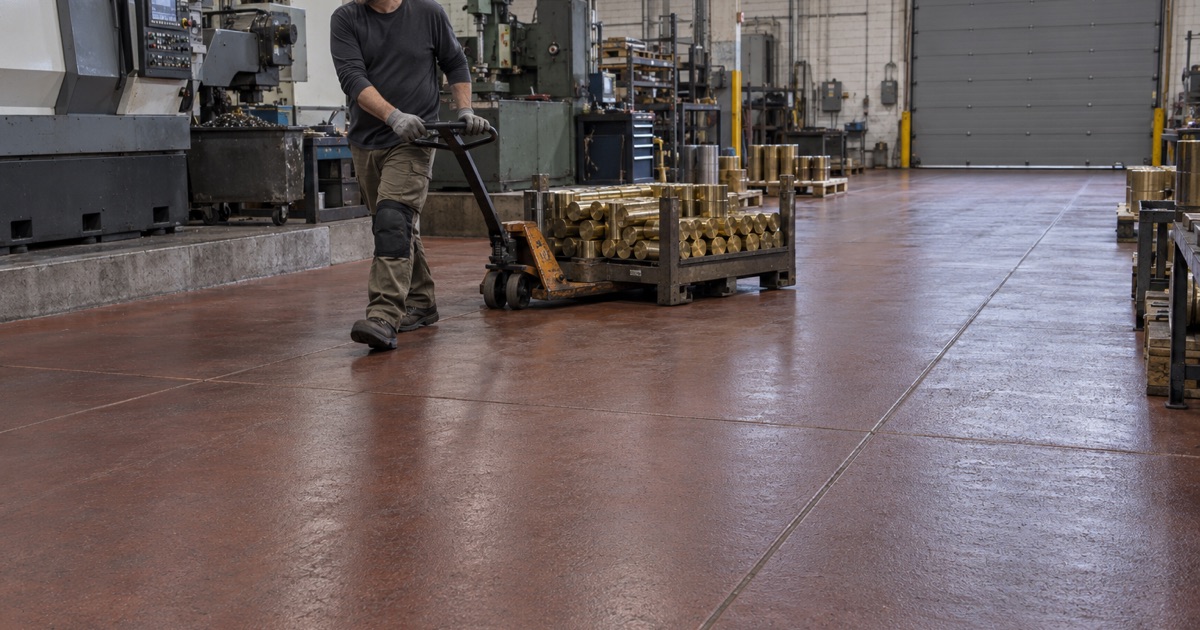
Thin-Film Coatings
Thin-film epoxy coatings are a few mils thick and work for light-duty floors such as storage rooms, dry assembly areas and some warehouses with only foot and light cart traffic. They are the least expensive option and the fastest to install.
Many cheap industrial quotes are thin-film systems presented as something heavier. On a floor that sees forklifts or dropped parts, a thin film wears through in the busiest aisles quickly, which is why we put the thickness in writing.
High-Build and Broadcast Systems
High-build systems apply thicker coats of 100% solids epoxy, often with a quartz aggregate broadcast between coats. The aggregate adds thickness, impact resistance and slip resistance, and the finished floor handles forklift and pallet jack traffic far better than a thin film.
These systems are the workhorse for manufacturing floors, shop areas and loading zones. Texture can be tuned from zone to zone, rougher where fluids hit the floor and smoother in dry areas that need easy cleaning.
Epoxy Mortar and Slurry Systems
Where impact, heavy loads or severe abrasion are constant, epoxy mortar or slurry systems are troweled down at much greater thickness. These floors resist gouging from dropped dies and parts and stand up to steel-wheeled carts that would shred a thinner coating.
Mortar systems are also used to rebuild damaged areas, fill low spots and create slopes to drains in a single application. They take longer to install but last far longer in the toughest spaces.
Chemicals, Heat and Contamination
Chemical Resistance in Metal Finishing and Plating
Plating, anodizing and metal finishing operations use acids, caustics and solvents that attack standard epoxy. Novolac epoxies and some urethane cement systems resist these chemicals far better, and the right choice depends on the specific chemicals, concentrations and how long spills sit.
We review your chemical list against manufacturer resistance data before choosing a system. A floor that resists one acid well may fail quickly against another, so this step is not one we guess at.
Heat, Thermal Shock and Wash-Down
Floors near ovens, hot process lines or areas cleaned with hot water face thermal shock, which can crack and debond standard epoxy. Urethane cement handles heat cycling and hot wash-downs much better and is the usual choice for those zones. We often combine systems on one floor, using urethane cement near heat and wash-down areas and high-build epoxy elsewhere, with clean transitions between them.
Oil-Soaked Slabs in Former Machine Shops
Old machine shops and fabrication buildings frequently have slabs saturated with cutting oil and hydraulic fluid. That oil keeps wicking out of the concrete and blocks a coating’s bond, even after the surface looks clean.
We degrease, shot blast or grind, then test the slab for remaining contamination. The results decide whether repeated cleaning, an oil-tolerant primer or replacement of the worst concrete is needed before coating begins.
Trench Drains, Slopes and Containment Curbs
Process areas often have trench drains, sumps and curbs that keep spills contained to one part of the floor. These details are where water and chemicals collect, and where a coating most often fails if its edges are not anchored properly.
We cut keyways at drain edges and terminations so the coating locks into the slab instead of ending on a feather edge, and we carry the system up curbs and into trenches where the specification calls for it. Slopes to drains can be rebuilt with epoxy mortar so liquids actually reach the drain instead of ponding.
Preparing and Scheduling Industrial Work
Shot Blasting and Heavy Preparation
Industrial floors are usually shot blasted to a deeper surface profile than residential floors, since thicker systems need more mechanical grip. Edges, trench drains, equipment bases and column lines are diamond ground so the profile is consistent everywhere.
Old coatings, failing repairs and damaged joints are removed and rebuilt before the new system goes down. Joints that move are honored with flexible fillers so the coating does not crack along them.
Moisture and Slab Condition
Industrial slabs on grade are tested for moisture before pricing, just like smaller floors, because vapor drive can blister even thick systems. Where readings run high, a moisture-mitigation primer goes down first. We also map cracks, spalls and settled sections, and tell you plainly when an area needs replacing before coating rather than hiding it under a new floor.
Phasing Around Production
Plants that cannot stop are coated in phases, by area, during overnight shifts, weekends or planned shutdowns. We agree on the sequence, access routes and return-to-service times with production and maintenance staff before work starts.
Cure times are set by slab temperature and dew point, not by the calendar, and in cold buildings we plan temporary heat or select products that cure at lower temperatures.
VOC Compliance
Cook County lies inside the Chicago 2015 ozone nonattainment area, and 35 Ill. Adm. Code Part 223 limits VOC content in industrial maintenance and floor coatings. Those limits apply to the applicator, and we confirm compliance for every product before it is ordered.
- 20+ Years on Concrete
- Moisture Tested Before Pricing
- Written Coat-by-Coat Proposals